Navigating the UK’s first-time buyer schemes is less about finding a “better” deal and more about understanding the different financial DNA of each option and its long-term consequences.
- Government schemes reduce your initial deposit by asking you to make an “equity trade-off”—you either share future property value growth or take on a loan that will eventually accrue interest.
- Comparing schemes requires looking at the “total monthly outlay” (mortgage, rent, fees, and service charges), not just the headline mortgage payment.
Recommendation: Map your financial five-year plan against each scheme’s structure to identify which option’s trade-offs and exit pathways best align with your personal circumstances and risk tolerance.
For UK first-time buyers, the landscape of government-backed mortgage schemes can feel like a labyrinth. You’re told these programmes are the key to the property ladder, yet the names—Help to Buy, Shared Ownership, Right to Buy—blur into a confusing mix of promises and complex rules. Most advice simply describes what each scheme is, listing generic pros and cons that do little to clarify which path is truly right for you. This often leads to analysis paralysis or, worse, a choice based on incomplete information.
But what if the key wasn’t just understanding what each scheme *does*, but deconstructing *how* they work financially? The real challenge isn’t memorising different deposit requirements; it’s grasping the fundamental financial DNA of each product. These schemes are not just slightly different routes to the same house; they are distinct financial instruments, each with its own unique set of trade-offs regarding equity, long-term costs, and future flexibility. Choosing the right one requires a strategic mindset, not just a mortgage calculator.
This guide moves beyond the brochures. We will dissect the underlying mechanics of the UK’s main first-time buyer schemes. We’ll analyse the hidden costs, compare the equity trade-offs, and provide a clear framework for you to decide not just which scheme you are eligible for, but which one strategically aligns with your financial goals. By the end, you’ll have the tools to navigate the system with confidence.
To help you navigate this complex topic, we’ve broken down the key comparisons and financial mechanics of the UK’s main government-backed mortgage schemes. Explore the sections below to build a complete picture of your options.
Summary: A Strategic Breakdown of UK First-Time Buyer Schemes
- How Much Does Help to Buy Save UK First-Time Buyers vs Conventional 95% Mortgages?
- How Does UK Shared Ownership Let You Buy a £250k Property With a £12,500 Deposit?
- Right to Buy or Help to Buy: Which Gets Council Tenants Better UK Property Deals?
- The Year 6 Shock: When Help to Buy Equity Loans Start Charging 1.75% Annual Fees
- Should You Buy Now With Help to Buy or Save 2 More Years for a Conventional UK Mortgage?
- Why Do Standard UK Mortgages Need Bigger Deposits Than Government-Backed Schemes?
- New-Build or Resale: Is the 20% Price Premium for UK New-Builds Worth Paying?
- How Does Government Insurance Backing Enable 95% LTV Mortgages for UK First-Time Buyers?
How Much Does Help to Buy Save UK First-Time Buyers vs Conventional 95% Mortgages?
The core appeal of the Help to Buy: Equity Loan scheme, though now closed to new applications in England, was its powerful impact on initial affordability. The scheme offered a 20% government loan (40% in London) on a new-build property, allowing buyers to secure a mortgage with just a 5% deposit. The “saving” wasn’t just in the smaller deposit; the true advantage lay in the financial structure. With the government loan covering 20%, buyers only needed a 75% LTV mortgage, unlocking much lower interest rates than those available for high-risk 95% LTV products.
The most significant financial benefit was the interest-free period. As the National Audit Office confirms, Help to Buy equity loans are interest-free for the first five years. This period allows homeowners to build equity and potentially overpay their mortgage without the added pressure of interest on the government’s portion. Compared to a 95% mortgage where interest is paid on the entire loan from day one, this five-year grace period represents a substantial cash flow advantage in the crucial early years of homeownership. This structure effectively separated the borrowing into a cheap mortgage and a free-for-five-years government loan.
However, this upfront benefit comes with a significant long-term trade-off. The government loan is a share of your home’s future value, not a fixed cash amount. If your property value increases, so does the amount you owe. An industry analysis found that across repaid loans, the government received a 10.3% uplift, showcasing the scheme’s success for the taxpayer but highlighting the cost to the homeowner. This leads to a critical warning from experts. As the National Audit Office highlighted in its review:
Furthermore, property owners could face the trap of negative equity, exacerbated by the new-build premium.
– National Audit Office, Help to Buy: Equity Loan scheme – progress review
This “equity trade-off” is the central compromise of the scheme. You gain immediate affordability in exchange for sharing future growth and accepting the risk of the new-build premium eroding your equity. It’s a powerful tool, but one whose long-term costs must be carefully weighed against the initial savings.
How Does UK Shared Ownership Let You Buy a £250k Property With a £12,500 Deposit?
Shared Ownership works by fundamentally changing the definition of “buying.” Instead of purchasing the whole property, you buy a share—typically between 10% and 75%—and pay rent on the portion you don’t own to a housing association. This is how it dramatically lowers the barrier to entry. For a £250,000 property, instead of needing a deposit on the full value, you only need a deposit on the share you’re buying. If you purchase a 25% share (£62,500), a 5% deposit would be just £3,125. Even a 50% share (£125,000) with a 10% deposit would require £12,500, a fraction of what would be needed for a conventional mortgage.
The illustration below symbolises this concept of partial ownership, where the keys to the property are effectively shared with the housing association.
This mechanism makes homeownership accessible to those with lower incomes or smaller savings. While the headline figures are compelling, it’s crucial to understand the “total monthly outlay.” Your monthly payment isn’t just your mortgage; it’s a combination of your mortgage on the share you own, plus rent and often a service charge on the part you don’t. A real-world example shows Olive bought 43% of a £309,700 flat, and her total monthly housing costs are £1,230 (£547 mortgage + £380 rent + £303 service charge). This total cost is the only way to accurately compare the affordability of Shared Ownership against renting or a conventional mortgage.
The deposit required scales directly with the share you buy, making it a flexible but complex calculation. The table below illustrates how the deposit changes based on the share purchased for different property values.
| Share Purchased | Share Value | 5% Deposit | 10% Deposit |
|---|---|---|---|
| 25% share | £37,500 | £1,875 | £3,750 |
| 50% share | £75,000 | £3,750 | £7,500 |
| 25% share (higher value property) | £75,000 | £3,750 | £7,500 |
| 50% share (higher value property) | £150,000 | £7,500 | £15,000 |
Your Action Plan: Auditing Scheme Eligibility
- Eligibility Checklist: List the core criteria for each scheme (Help to Buy, Shared Ownership, Right to Buy, Mortgage Guarantee). Note income caps (£80k/£90k for Shared Ownership), first-time buyer status, property type (new-build only for Help to Buy), and tenancy status (for Right to Buy).
- Deposit & Savings Inventory: Collect your exact savings figure. Compare it against the minimum deposit required for a 25% share in Shared Ownership vs. a 5% deposit for the Mortgage Guarantee Scheme on a target property price.
- Income & Affordability Test: Use an online calculator to get your mortgage-in-principle amount. Confront this with the share values in Shared Ownership or the 95% loan under the Guarantee Scheme to see what’s realistic. Factor in rent and service charges for a “total outlay” figure on Shared Ownership.
- Long-Term Goal Alignment: Create a simple 5-year goal grid. Do you prioritise 100% ownership quickly (favours Mortgage Guarantee) or lowest initial cost (favours Shared Ownership)? Does the risk of shared equity (Help to Buy) fit your risk tolerance?
- Broker Preparation Plan: Consolidate the above points into a single document. This turns your conversation with a mortgage broker from “What can I get?” to “Based on my £X deposit and £Y income, is the exit pathway from Shared Ownership or the fee structure of Help to Buy better for my goal of 100% ownership in 7 years?”
Right to Buy or Help to Buy: Which Gets Council Tenants Better UK Property Deals?
For council tenants aspiring to homeownership, the choice between Right to Buy and a scheme like Help to Buy (when it was available) presented two very different pathways. Right to Buy offers eligible tenants the chance to purchase their existing council home at a significant discount. Historically, this discount was the scheme’s main draw, providing instant equity and a massive head start. Help to Buy, conversely, was focused on new-build properties and offered an equity loan, not a discount. The “better deal” has always depended on the size of the Right to Buy discount versus the financial leverage of the Help to Buy loan.
However, the landscape has shifted dramatically. The value of the Right to Buy scheme as a “deal” has been severely diminished for many. A major policy change has seen the maximum discount available slashed. In what was a significant blow to the scheme’s generosity, the maximum cash discount was reduced from £102,400 (£136,400 in London) to a range of just £16,000–£38,000 depending on the region. This turns a potentially life-changing subsidy into a far more modest helping hand.
This reduction fundamentally alters the comparison. While Help to Buy involved taking on a loan and sharing future equity, its 20% equity loan on an average-priced new build could easily be worth more than the new, lower Right to Buy discount. Industry experts were quick to point out the impact of this change on aspiring homeowners. As Ryan Etchells of Together commented:
The Chancellor’s reduction in the discount allowing tenants to buy their council homes under the Right-to-Buy scheme will mean they will have to pay, in most cases, tens of thousands of pounds more to be able to get on the housing ladder.
– Ryan Etchells, Chief Commercial Officer, Together, Property Reporter
With the drastic cut to the discount, the calculation for many council tenants now tilts away from Right to Buy. While owning your current home has emotional value, other schemes that offer greater financial leverage, such as Shared Ownership or those backed by the Mortgage Guarantee Scheme, may now present a more financially viable route onto the property ladder, even if it means moving to a different property.
The Year 6 Shock: When Help to Buy Equity Loans Start Charging 1.75% Annual Fees
The financial DNA of the Help to Buy Equity Loan is defined by its two distinct phases: the initial five-year interest-free period and the subsequent fee-paying period. The “Year 6 Shock” refers to the moment this transition occurs. From the beginning of the sixth year, homeowners start paying an annual fee of 1.75% on the outstanding equity loan. Crucially, this isn’t a fixed fee. The financial structure dictates that it increases annually, creating an ever-escalating cost.
The escalating nature of this fee is what makes it a “shock” for those unprepared. As the image below symbolises, what starts as a small cost can cast a long and growing shadow over your finances.
This escalation isn’t arbitrary; it’s built into the scheme’s rules. Official documentation from Homes England confirms that from year 6, interest rises annually by CPI + 2%. In a high-inflation environment, this formula can lead to sharp and unpredictable increases in monthly outgoings. This fee does not reduce the capital of the loan; it is purely a charge for borrowing. The only ways to stop paying it are to either sell the property or repay the equity loan in full, often by remortgaging.
This fee structure creates a powerful incentive for homeowners to find an “exit pathway” before or shortly after the sixth year. The goal for many becomes to remortgage and absorb the equity loan into their main mortgage, a process that requires sufficient equity in the property and meeting the lender’s affordability criteria. The scale of this is significant; industry tracking shows that 181,437 households have already fully paid off their government equity loans. This demonstrates that a vast number of buyers treat the five-year interest-free period as a hard deadline, actively planning their exit to avoid the escalating fees.
Therefore, the Year 6 Shock isn’t just a date on a calendar; it’s a critical strategic deadline that should be factored into any decision to use the scheme from day one. A failure to plan for this transition can turn a helpful starting loan into a long-term financial burden.
Should You Buy Now With Help to Buy or Save 2 More Years for a Conventional UK Mortgage?
This is the classic dilemma for first-time buyers: leverage a government scheme to get on the property ladder now, or wait and save for a larger deposit to secure a conventional mortgage? The decision boils down to a trade-off between the opportunity cost of waiting versus the financial complexities and potential long-term costs of schemes like Help to Buy. Waiting means trying to save a deposit while house prices and rents are potentially rising, a race that can feel impossible.
The numbers involved are daunting. To secure a conventional mortgage without relying on a government scheme, buyers need a substantial deposit. While 5% deposit mortgages exist, many lenders prefer 10% or more, and a larger deposit unlocks better interest rates. The scale of this savings challenge is significant; recent market data indicates that the average UK first-time buyer deposit was £53,414, representing around 19% of the property price. Saving such a sum can feel like a monumental task, especially when also paying rent.
This is where the opportunity cost becomes stark. A study analysing the time it takes to save a deposit highlights the real-world delay. It found that the average first-time buyer in London might have to save for nearly nine years (104 months) to afford the deposit for a £425,000 property, assuming they save 10% of the mean gross salary. This long saving period means missing out on years of potential property value growth and paying rent instead of building equity. This is the powerful argument for using a scheme to buy now.
Schemes like Help to Buy (when available) or the Mortgage Guarantee Scheme effectively allow buyers to short-circuit this long saving period. They bridge the gap, enabling a purchase years earlier than would otherwise be possible. While these schemes introduce their own costs and trade-offs—such as sharing equity or paying for lender insurance via higher rates—they provide a crucial benefit: getting into the market. For many, the financial and personal benefits of starting their homeownership journey two, five, or even nine years earlier outweigh the complexities that come with government assistance.
Why Do Standard UK Mortgages Need Bigger Deposits Than Government-Backed Schemes?
The fundamental reason standard mortgages require larger deposits comes down to one word: risk. From a lender’s perspective, the deposit is a buffer. The Loan-to-Value (LTV) ratio—the size of the mortgage as a percentage of the property’s value—is their primary risk metric. A 95% LTV mortgage (requiring a 5% deposit) is far riskier for a bank than an 80% LTV mortgage. If the borrower defaults and house prices have fallen even slightly, a 5% deposit can be wiped out, leaving the lender with a loss after repossessing and selling the property.
To compensate for this higher risk, lenders do two things: they either refuse to offer high LTV mortgages altogether, or they charge a premium for them. This premium comes in the form of a higher interest rate. As market analysis shows, the interest rate on a 95% LTV mortgage can be 0.3–0.6% higher than on a 90% LTV product. On a typical £285,000 mortgage, this can mean paying up to £140 more each month, a direct cost passed to the borrower for the lender’s increased risk.
This is where government-backed schemes change the game. They don’t eliminate the risk; they transfer it away from the lender and onto the government. Schemes like the Mortgage Guarantee Scheme act as a form of insurance for the bank. As the New-Builds.co.uk mortgage guide explains:
The government guarantees the lender against losses on the portion of the mortgage above 80% LTV (i.e., the riskiest 15% of the loan). If you default and the property is repossessed, the government compensates the lender for losses on that top slice — up to a cap.
– New-Builds.co.uk mortgage guide, Mortgage Guarantee Scheme for New Build Buyers
By providing this guarantee, the government effectively de-risks the loan for the lender. A 95% LTV mortgage suddenly looks as safe to the bank as an 80% LTV one. This gives them the confidence to offer these high LTV products to a wider market of first-time buyers who have good affordability but haven’t had the years required to save a 10% or 20% deposit. The bigger deposit on a standard mortgage isn’t just a rule; it’s the lender’s self-preservation mechanism in the absence of a government safety net.
New-Build or Resale: Is the 20% Price Premium for UK New-Builds Worth Paying?
The “new-build premium” is a well-documented phenomenon in the UK property market. It refers to the higher price a brand new property typically commands compared to a similar-sized, older property in the same area. This premium can be as high as 20%. For first-time buyers, many of whom are guided towards new-builds by schemes like Help to Buy, the question is whether this premium is a fair price for a modern, energy-efficient home or a hidden cost that can instantly erode equity.
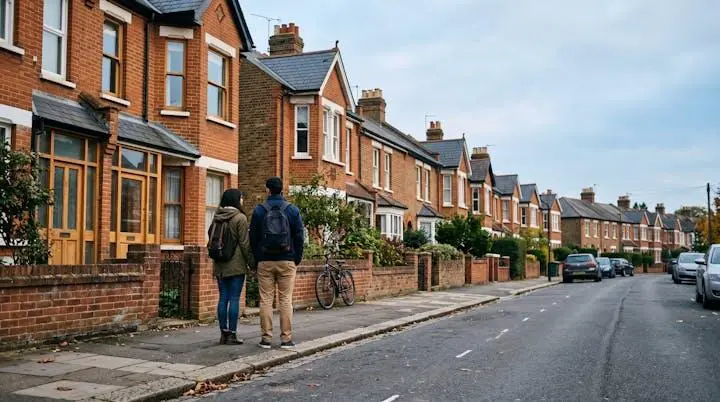
The argument for the premium is that you are paying for tangible benefits: modern construction standards, higher energy efficiency (leading to lower bills), and the peace of mind that comes with a 10-year NHBC warranty. There are no renovation costs, no hidden surprises from a survey, and the home is a blank canvas. The contrast between a modern development and an older street, as seen in the image, highlights the different aesthetics and living environments you are choosing between.
However, the risk is that this premium is volatile. As one expert guide explains, “The new build premium is the tendency for new properties to sell at a higher price than comparable existing homes. This premium can diminish once the property is no longer new.” In simple terms, the moment you get the keys, your brand new home becomes a second-hand one, and its value may realign downwards towards the local resale market. This is why lenders are often more cautious with new-builds, applying stricter LTV limits; they are protecting themselves against this potential drop in value.
Interestingly, data from government schemes suggests that buyers using them often purchase properties below the national average price. Official government scheme statistics reveal that the mean property value under the Mortgage Guarantee Scheme was £211,616, significantly lower than the UK average house price of £268,000 at the time. This indicates that while a premium may exist, scheme users are often buying smaller or more affordable new-build properties. Ultimately, whether the premium is “worth it” is a personal calculation, weighing the tangible benefits and lack of hassle against the financial risk of immediate depreciation.
Key Takeaways
- Government schemes lower the deposit barrier by introducing an “equity trade-off,” either through a loan tied to your home’s future value (Help to Buy) or by selling you only a share of the property (Shared Ownership).
- True affordability can only be compared by calculating the “total monthly outlay,” which includes mortgage, rent, service charges, and escalating fees—not just the mortgage payment.
- The government’s primary role in these schemes is to “de-risk” the loan for the lender, either by providing an insurance-like guarantee or by taking on an equity stake themselves, which is what gives banks the confidence to lend at 95% LTV.
How Does Government Insurance Backing Enable 95% LTV Mortgages for UK First-Time Buyers?
The availability of 95% Loan-to-Value (LTV) mortgages is often a barometer of the mortgage market’s health and confidence. When lenders are cautious, these high-risk products are the first to disappear. This was seen starkly during the economic uncertainty of the pandemic, when 95% LTV mortgages became almost extinct. To restart this segment of the market and prevent first-time buyers from being locked out, the government stepped in not as a lender, but as an insurer, through the Mortgage Guarantee Scheme.
The scheme’s financial DNA is simple but effective: it provides a government guarantee to lenders for the riskiest portion of a 95% mortgage. This guarantee covers the portion of the loan between 80% and 95% LTV. If a borrower defaults, the government compensates the lender for their losses on that top 15% slice. This doesn’t remove the risk of default, but it transfers the financial consequence from the lender to the taxpayer. As the HomeOwners Alliance explains, the scheme was explicitly “designed to give lenders a government-backed guarantee to encourage them to offer 95% mortgages.”
This government backing gives lenders the confidence to write loans they would otherwise deem too risky. It effectively makes a 95% LTV mortgage look, from a risk perspective, much more like a safer 80% LTV mortgage. The result was an immediate reopening of the high LTV market, making homeownership possible again for thousands of buyers with smaller deposits. The success and scale of the scheme are evident in the numbers; official quarterly statistics show that more than 53,000 mortgages have been completed under its umbrella.
Unlike Help to Buy or Shared Ownership, the buyer has no direct interaction with the scheme itself. It’s an arrangement between the lender and the government. The buyer simply applies for a standard 95% mortgage from a participating lender. The “cost” to the buyer is often indirect, coming in the form of a slightly higher interest rate compared to lower LTV products. The scheme is a clear example of how government intervention can manipulate market risk to achieve a policy goal—in this case, keeping the dream of homeownership alive for those with a 5% deposit.
By deconstructing the financial DNA of each scheme, you can move from a state of confusion to one of strategic clarity. The right choice depends not on a universal “best” option, but on which scheme’s unique set of trade-offs best aligns with your personal financial situation and five-year goals. The next logical step is to take this newfound understanding and apply it to your own numbers, mapping out the total monthly outlay and long-term equity implications of each viable path.